Monday, 14 March 2022

I'm still here 2022 pre-season nets

 I think everyone who plays at our club have come through Covid 19 okay. The next worry is Putin and things like food shortages and the cost of fuels - cars and heating next winter. But in the short term... Cricket!

So, a quick re-cap. The last 2 years I've been bowling flippers. The issue with my knees was resolved through self governed physio and rest and it seems the likely issue was weak glutes and and core. That exacerbated by over doing extreme exercises. The man I follow for my strength and conditioning is this bloke here... (Double click the image). 


The Flippers worked well and I bowled them 95% of the time and people just couldn't deal with them. But last summer my run-up went wrong and I developed a stutter in the run-up that I couldn't resolve. Towards the end of the season I started to bowl off a 2-3 step walk in and it worked okay in some instances. 

So, week 2 of pre-season nets I've been bowling primarily off of 2- 3 steps and it's working for me. I've tried a couple of long run-ups for the Flipper bowling, but the run-up is still a mess. The interesting thing though is that I've bowled a line that I've always avoided in the past. Over the stumps into the leg-stump area with leg-breaks. There's an awkward blind spot there where the ball can potentially disappear for a split second and this can be exploited to an extent. Added to this I'm also attacking the stumps with the ball turning.

My normal perception is that bowling this line is a high risk strategy as most batsmen fancy themselves to be able to hit the ball over the boundary. Before he died I watched a video or saw Warne on a SKY program saying that when you bowl you need to be able to tell me what your plan is... "How you going to get me this blokes wicket"? Thinking this through in terms of my own bowling, my approach has always been wholly reliant on good wicket keeping, slips and fielders on the off-side with no hope of hitting the stumps as I'm always turning the ball away from them. 

So now my response to the same question would be...

(1). I'm trying to turn the ball into the stumps and bowl the batter round their legs.

(2). With the ball outside of leg and spinning, the batter is going to sweep/slog the ball leg-side to a packed field (See below) and someone's going to take the catch.

But add to this approach the fact that I've been bowling Flippers now for 2 seasons and they have a handful of attributes as I bowl them in a number of variations...

(a). A conventional back-spinner with an upright seam which is a much faster change up and is straight. (b). The same ball but stupidly loopy and slow that almost stops because of the back-spin - LBW or bowled option. (c) The same back-spinner with a crossed seam and again much faster or slower - but straight again, but with the addition of the crossed seam comes weirdness off the wicket and swerve in the air. 
(d). An off-spinning flipper which I used tonight against one of the best bats at our club and I clean bowled him as he played for the leg-break, but the ball had just a little off-break to it.

Finally my top-spinner is back and that keeps the batsman on their toes and a few of them bounced and were hit high up the bat for potential C&B.

The interesting thing though was the better batsmen struck the ball as expected through zone A in this diagram and the really good bloke back up the wicket past me tight or an on-drive to "7" (Long Mid on), so the chances are they may have been singles or I may have attempted to catch them in a game scenario. 

I think next week I'll show them this field diagram and say play me as though I had this field set and see what they do. I'll record where the ball goes as well and see if this works. I know that if I get the line wrong I'll go for runs through the off-side.


21st March nets.

It didn’t go that well. All my plans went to pot and I bowled poorly and there’s nothing to report.

28th March nets

This was a different story though. Had some decent bats in my net so potentially a real challenge. I didn’t dabble with my run up and kept it simple coming in off just 2-3 steps. Going with the loose grip, cocked wrist and lowish arm angle – the aim was to get it up above the eyes just around 6” – 12” outside of the leg-stump on a good length. It’s pretty obvious that the length is key and getting the ball turning. Taking a leaf out of Warne’s book to some extent I bowled the initial ball on the off-side just to see if I could get the ball to turn. I guess this would be a good approach in a game when you start your spell as the batter doesn’t know what you’re about to do and if it turn’s you’re already getting in their head potentially? I did that and the batter played and missed trying to cut the ball.

Thereafter I went either straight or on my intended line and pretty much bowled with good accuracy, a few wide balls, but for the most part where I wanted it and yes it caused problems. The only other balls I’m using are the off-spinning Flipper and a Top-Spinner and the combination works. The off-spinning flipper looks particularly dangerous with the batters saying they can’t pick it. Varying the speed obviously helps and causes problems too. It all looks promising. The only thing I can put my finger on that I did differently was some stretches? 


Sunday, 25 April 2021

Knee update - ongoing through the 2021 season

 It seems that if anything is going to stop me playing cricket or at least stop me from bowling it's going to be my knees.

Back in February I mentioned that the left knee felt like it was the more susceptible to further issues, but after the first game of the season where I've only bowled 5 overs, the right knee is the one that feels sore and the soreness is in the back of the knee rather than the front and it's still sore 24 hours later. Not swollen, just sore I might roll it and see if that make it feel any better, but I check to see if that's a good idea first!

8th May 2021

Played a couple of weekends on the trot and both games got through with no real flare ups or swelling, but some soreness and feeling of being 'Full' in the back of the knee, sort of a water on the knee feeling. Was scheduled to play this weekend (8th), but the game was called off thankfully as towards the end of the week my knee grew ever more sore with some limited swelling which I kind of reckon would be described as possibly being 'water on the knee'. Looking at all the description of what it might be it seems most likely to be connected to the popletius. Anyway it's the right knee and it's sore rather than painful and at the moment (8th of May) it feels as though I'd be unlikely to play this coming weekend. 

https://www.sportsinjurybulletin.com/popliteus-assessment-and-rehabilitation/

This link above has got some useful stuff. 

And this one in particular https://www.cricketgraph.com/knee-injuries-and-cricketers-a-better-way-to-prevent-knee-injuries/

I need to use inner soles with a higher arch.

https://www.youtube.com/watch?v=PhYwEr4BgRE

Warm up before bowling https://www.youtube.com/watch?v=FYfbmqdpjkI

Bowling warm up https://www.youtube.com/watch?v=A3c2HmCzYr8

Saturday, 17 April 2021

First practice of 2021 with Joe and Ben!

 There had been a practice session a couple of nights ago, but what with it being freezing cold and getting in late we 'Longed it off'. A couple of night later it was 'Sign up' night at the club and I went down -paid my subs and paid for a months worth of games. While I was there I heard there was a chance for a practice this Saturday (Today) and I was up for that at 12.30. Joe said he'd go and my older son Ben who played up till he did his GCSE's said he wouldn't be going "Last thing I want to do - do I look like a 'Crack head'"?

It was a lovely crisp sunny day, the frost had melted a few hours beforehand and it was dry with a light breeze. I got my gear ready including some new cricket shoes, woke Joe up and got ready. As I got the bags in the car, Ben came out and said "Yeah I'm coming" and so for the first time in a few years all three of us practiced together. We're all bowlers and we all seemed to bowl okay, they were a bit knackered and sore after as they don't really do any exercise. I took loads of wickets - hitting the stumps with both Flippers and Leg-Breaks. Joe had a good day with the bat. I think Joe is better than his usual No.11 and he batted really well by all accounts today and he was well chuffed and said that he actually enjoyed it. I've always said that as he gets older he'll just get more confident and less fearful and he said he was fine, but conceded that if any of our quick's had been there he may have felt different. Ben took his wicket and he said that Ben was surprisingly quick given he's not picked up a ball in years. Joe was enjoying it so much he didn't want to come home!

The good thing was Ben (older son) wasn't negative about it and I've suggested that maybe he plays in the 4's and just play away games or something? We'll have to see...

Next game is Saturday 24th over at Mopsies and that's an interclub game, I'm really looking forward to that. Can't wait!

Saturday, 10 April 2021

Bit of exercise

 With the season closing on us fast and no nets again this year, exercise has been few and far between other than stuff that I can do indoors. I'm not one for running around the streets or muddy woods as it bores me to tears, but over the Easter break I've been doing some serious gardening and that's helped out a bit as in the last couple of days I've been for a walk and round my circuit in the local woods and bowled 60 balls in a session yesterday and both went okay. In fact the walk/run around the circuit has gone pretty well with recovery rate data to suggest I'm doing quite well.

The wood walk/run takes about 19 mins and I use and interval timer that bleeps every 2 mins. I walk as fast as I physically can and on the bleeps I run for about 20 seconds. Dependent on fitness levels the 20 second run bit is done as fast as I can physically do it and this is supposed to replicate cricket scenarios - running between wickets and fielding where, you're not continuously running, but running sporadically. 

The first of these run/walks yielded a recovery rate of 26 two days ago and today with some bowling done yesterday the recovery rate improved to 36. So over the next couple of weeks I'm going to see if I can get it up to the 59 + region as per the chart below.

https://www.sundried.com/blogs/training/heart-rate-recovery-and-fitness-levels

Heart Rate Recovery

How fast your heart rate can return from high intensity near max bpm to resting rate is known as your heart rate recovery.  HR Recovery is measured after performing strenuous exercise for a given period of time and then measuring how far your heart rate drops two minutes after stopping that exercise. For example, sprinting on a treadmill as fast as you can for around 2 minutes. Follow this with a heart rate reading and then rest for 2 complete minutes and take your heart rate again. To calculate your heart rate recovery rate you now subtract the two numbers.

Findings: (These recovery results were taken from Enhanced Medical Care).

  • Less than 22: Your biological age is slightly older than your calendar age.
  • 22-52: Your biological age is about the same as your calendar age.
  • 53-58: Your biological age is slightly younger than your calendar age.
  • 59-65: Your biological age is moderately younger than your calendar age.
  • 66 or more: Your biological age is a lot younger than your calendar age.

The bottom line? The faster your heart rate returns to normal, the higher your level of fitness.

Medical research also supports this analysis of heart rate recovery. According to the New England Journal of Medicine, people whose heart rate recovery times are longer are at a higher risk of death than people with shorter recovery times, regardless of physical condition or other risk factors. Another study by the National Emergency Medicine Association found measuring heart rate recovery rates is one way to tell whether an exercise program is effective.

Saturday, 20 February 2021

Flipper - off-spinning variation

 The last two seasons I've been playing at a much higher level than I ought to be playing in my opinion and I've had to adapt to the situation and change my bowling. So I've been bowling flippers coming in off a much longer run-up than I have ever done and it's worked for the most part. Only once have I been aware that anyone's sussed out what I've been doing and that was young bloke from one of the Southend teams who I heard say to his Dad 'He's bowling back-spinners' and he was taking me and everyone else to the cleaners.

I've kept it really simple, mostly I'm bowling cross-seamed with the occasional up-right seamed delivery. I vary the speeds and how much spin I put on the ball and rarely I try the one out of the front of the hand with a bit of off-spin, but I've found that rarely turns and if it does it's minimal. Recently at home I was thinking about the potential of the off-spinning variation and realised that it would probably work so much better with a lower arm angle. I bowl with a very upright arm and getting the wrist into an appropriate position to release a flipper with off-spin is tricky, but my initial experiments indoors seem to indicate that simply by lowering my arm may yield benefits. Another observation is that it still retains the back-spin aspect, so it does actually work it'll be an off-break with back-spin which is an unusual delivery. 

Knee situation 2021

 The knee saga...

Last spring probably did me a favour with the Covid situation, as it mean that there was no cricket till late June? So I had all of Spring and the early part of the summer basically doing rehab. Walking for most of the time interspersed with short bursts of running. By the time we got some cricket my knee felt fine. So good I didn't really know which knee had been giving me grief.

Since Sept 2020 though, I like a lot of people haven't been doing a great deal physically apart from some Yoga and stretching and upper body strength exercises focusing on arms and shoulders. Sitting around all the time though, I'm aware that this is a potentially a bad move with regards weakening the butt muscles and eventually that impacts on the knees. I do a fair bit of flexibility exercises and put my knees through a bit of a going over doing this and I'm aware that the left knee feels less flexible or potentially susceptible to future issues, but I'm hoping as we come out of the winter and lock-down this year I can start getting out and about and exercising in readiness for a new season.

Talking of which there seems to be some really good news. It seems that we've got 10 new adult players and they sound like they're all South Asian blokes, so that bodes well on so many fronts. In addition to that there's a big crop of younger players coming through this year as well. So many it seems, that we're definitely going to be able to field 4 teams for the first time in 3 or 4 years! Hopefully there's some batters among them because that's what we seem to be missing! Hopefully, I'll get to play in a team that suits my age and abilities rather than playing 2nd XI and 3rd XI cricket! I might actually get some wickets!

Sunday, 19 July 2020

Scoring symbols - bowlers analysis

Scoring's an interesting aspect to cricket and it's a shame that increasingly there's a move towards using digital systems for recording scores. I came late to cricket and had no idea of how involved scoring was and was intrigued when I looked over the shoulders of people doing it, filling in all the little boxes with weird symbols.

I've never fancied the idea of umpiring and quickly saw that if chose to score I'd be alleviated of the job of umpiring and so began to watch people doing it and asking them questions. One thing I quickly noted was that there was no one way of doing it. Different people did it in different ways, so when I was learning, I had different people saying do it this way or that way. When it comes down to it you need to learn the basics and then listen to what different people say and adopt your own way. Of course there are courses that you can do and some clubs are prepared to send players on such courses, but if you're playing at the lower levels this isn't necessary.

What is disappointing is that, as much as I try I can't get kids to do it, even my own son is fairly reluctant, but has learned to do the basics.

On-line there are a number of different resources and I'm currently trying to put together a series of videos on Youtube to help people.

The thing is if you don't get it right and you use unorthodox methods, you'll pass on those methods to others, so it's important to standardise the process as much as possible. I've knocked up this post in response to my bowling figures being inflated because of the lack of knowledge with regards how to record byes and wides primarily. I know from experience that if you get it wrong and the results of the match are tight, what you've done is pored over and scrutinised and it can lead to embarrassing and tense situations at the end of the game. This is my take on how it's done and if I'm honest just by writing this blog and having to check what I'm writing is correct I've learned a couple more things about how to do it correctly. I'm not saying this is the definitive way of doing it and there may be things that I'm still doing wrong? If I am let me know.
_________________________________________________________________________

Figure 1


Multi-colour or single colour? I started out using a black/blue penwhen scoring, but in the last year or so I've started to use multi-colour pens. When each of the bowlers is assigned a different colour (Figure 1) and you combine this with marking the balls the batters face in the batting "Runs scored" row using the same colours as the bowler (Figure 2).

Figure 2


You might find it makes it far easier to check your figures at the end of the overs and at the end of the innings when you check everything consolidates.

Bowlers analysis box symbols________________________

1st Over F.Blogs 
Figure 3


One of the first things to consider especially if you're scoring youth matches or any game with potentially sketchy bowling is the size of your symbols in the boxes. If you get into a situation where numerous wides are bowled, you're going to run out of space and potentially may need to use the notes section to record data that you can't fit into the bowling analysis boxes.

Figure 3 In this box the bowler has bowled six balls that haven't gone for runs so 6 dots are recorded. No runs in an over is maiden indicated by an 'M'. In the running tally I've marked 0-0... No runs for no wickets or vice versa.

Score sheet layout 
Figure 4


Below (Figure 2) is how it could be recorded in the batters 'Runs scored' section of the score-sheet.
Batting row "Runs scored" Figure 2


One of the advantages of using coloured pens for scoring is that it makes it easier to establish who was facing who and this is often helpful if you lose track of where you are and ensuring your figures add up when you do the end of over checks.
Figure 3
______________________________________________________________________

(B). In this box we have 5 x dot balls and a small w which indicates a wicket has been taken. Therefore no runs have been scored and this is a wicket maiden indicated by the W. 
Note in the tally box beneath the symbols is the running total of the runs and wickets 0-1 indicates that no runs have been made for 1 wicket. A lot of people write this up the other way round e.g. 1 wicket for no runs, but you simply need to be consistent with the way you do it for each match.

In the box between (B) and (C) runs have been made. The first ball is a dot ball, the 2nd is run for a single, the 3rd ball 2 runs are made, the 4th ball - 2 runs followed by 2 dot balls e.g. no runs. Overall in that over, 5 runs are made so the tally in the box below now reads as 5 runs for 1 wicket (5-1).

(C). The + symbol is used to indicate a wide has been bowled. In this instance no runs have been made as a result of the wide. The + is counted as 1 run against the bowler.

Scenario - The bowler bowls a wide, the keeper collects the ball and no runs are made. The Umpire calls "Wide ball" and signals the wide you acknowledge the symbol.

  1. In the 'Runs scored' batsman's row, a dot is recorded.
  2. In the cumulative total 1 run is recorded for the wide.
  3. In the extras box, 1 is added in the wides section.
  4. The cross (Wide) is added in the bowlers analysis.
  5. In the 'Bowlers analysis to the right, there's an additional section in which to record the wide and it's useful to do so.
In box (C) the wide (1 run) is followed by 2 dot balls and then 2 balls that the batters run 2 for and then 2 more dot balls. The total for this over is 5 runs against the bowler bringing the running total up to 10 for 1. Note; Wides are not legitimate balls, so an additional ball has to be bowled, so in that box you'll see 7 (D) symbols as opposed to the normal 6 symbols. 

(E). Wides with runs; In this over, the first ball is a wide, so again the cross is used, but a single run is made (See below).
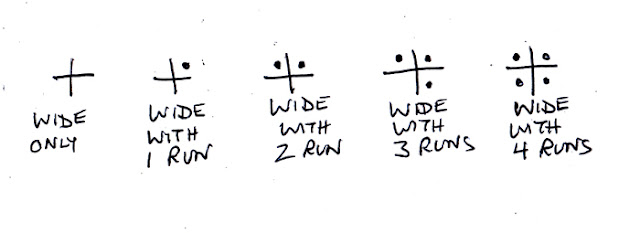
Figure 4


The run is indicated by the use of a dot in one of the quadrants of the cross. If two runs are made off the wide, 2 dots are marked in separate quadrants and so on. If the ball is bowled as a wide and runs across the field of play and crosses the boundary that is marked in the bowlers analysis in the same way. Note as mentioned before if you have bowler with the Yips this starts to get messy and you need to have contingency for a situation where multiple wides are bowled. Remember too that for every wide another ball has to be bowled as a wide doesn't count as a legitimate delivery.


So in the box (E) We have a wide that has one run made, followed by 2 runs, then 4 dot balls, followed by a wide with 2 runs made and then a final dot ball. 8 separate entries 2 wides and 6 legitimate balls.
Figure 5

  1. The first wide with the 1 run = 2 runs against the bowler.
  2. The 2nd wide with 2 runs = 3 runs against the bowler.
  3. Add the 2 regular runs made off the 2nd ball, the runs against the bowler in this over add up to 7 in total meaning the running total is now 17 for 1.
  4. Note on the right hand side in the wides column the 2 and 3 wides have been recorded.
  5. The runs from the wides must be recorded in the cumulative tally.
The 5 wides would also need to be recorded in the Extras and in the cumulative tally. The runs gained as a result of the poor bowling are NOT credited to the batters and are recorded as dots in the batting row.

(G) Byes; These are not credited to the bowler. 

Despite the fact that Byes (And leg-byes) are not credited to the bowler, they still have to be recorded in the bowlers analysis, but the bowler is not penalised... 

The bowler has bowled a good delivery and it's either glanced off the batters body (Leg-Bye) or everyone has missed it (Batter and wicket keeper) and the ball has evaded all of the fielders enabling the batters to run.

In the bowling analysis for A.Nother in the first box marked (G) we see the symbol for a Bye which is an upward pointing triangle. In the bowlers analysis this is worth nothing and some scorers don't even use a bye symbol and simply mark a dot ball, but this I feel is bad practice as if you're struggling to make sense of your scoring when it comes to adding everything up and checking the data at the end of the innings, the use of the correct symbols helps with the process.

Scenario; The bowler bowls a legitimate ball, it misses everything and it beats the wicket keeper for pace and runs down towards long off. The batters see that no-one is going to field the ball and make 2 runs before the fielders get the ball back to the keeper/bowler.
  1. In the batters row (Runs scored) you have the option of marking dots or the Bye symbol, some scorers don't mark anything.
  2. The two runs must be added to the cumulative tally.
  3. In the extras box the 2 runs have to be added in the Byes tally.
  4. Finally the bye symbol is added to the bowlers analysis -  you do not record the runs made as a figure in the bowlers analysis, otherwise they will not tally up correctly at the end of the innings/game.
(H) Leg Byes; These are not credited to the bowler and the rules are as above for Byes except that the symbol is downward pointing triangle. 

(J) Maiden with Byes/Leg-Byes. If in the over the bowler bowls a series of dot balls as in the case of a normal maiden (See above in section 'A') but one or more of the balls goes for runs off of either Byes or Leg-Byes which is no fault of the bowler, the over is still a Maiden and the M should be written in the box in the usual manner to indicate it is a Maiden.

___________________________________________________________________________

(K) No-Balls with runs off the bat
Scenario - The bowler runs in and bowls an illegal ball and the Umpire calls "No-ball"! The batsman strikes the ball hitting it for six in the case below in the bowlers analysis for (K). 
Figure 6
In this instance the No-Ball is down to the bowler, so the bowler is penalised heavily, with the No-Ball indicated by the circle and then any runs made off the illegal delivery credited to the bowler. The batsman in this instance has hit the ball for six, so the six runs appear in the circle.
Figure 7


Figure 8


How-ever many runs the batsman scores having hit the ball, these are recorded inside the circle as a number.

Additionally at the end of the bowling analysis row on the right-hand side, see image above circled in black, the 7 runs (1 for the No-Ball and 6 for the runs off the bat) should be recorded. The other two singles that are recorded in that same column in the circle are for the No-Balls associated with the leg-byes and byes in columns L and M.


(L) "No-Ball byes". Scenario - The bowler runs in and bowls an illegal ball and the Umpire calls "No-ball"! The ball then either evades the batsman and the wicket keeper and runs away enabling the batters to run byes; or the ball strikes the batsman's body and runs away enabling the batters to run Leg-Byes. In this instance we'll say they run 2 runs. So they get 1 run for the team for the No-Ball and then 2 runs for the team for the Byes or Leg-Byes run.

  1. In the batting row "Runs scored" you have the option of entering nothing or a dot or a Bye symbol, the batsman gains no credit for the runs accrued.
  2. In the Cumulative Tally you add 3 runs - 1 for the No-Ball and 2 for the Byes/Leg-Byes run.
  3. In the extras box - 1 is added to the No Ball row and 2 is added to the Byes/Leg-Byes.
  4. In the bowlers analysis (See below) a circle is used to indicate the No-Ball and in the circle you have the option of using a upward pointing triangle for Byes or as in (M) a downward pointing triangle for Leg-Byes. 
  5. . You do not have to record how many runs were accrued as a result of the batters running - these have already been recorded in the extras section and the bowler is not penalised for the runs from Byes/Leg-Byes. The bowler is penalised for the No-Ball and when adding up the bowling figures the circle counts for 1 run. 
  6. On the right hand side of the bowling figures at the end of the row you need to record the No-ball element, but not the runs.
Figure 9

Figure 10


To be continued...


...


If you're not sure still, I found the best way to learn was to sit in front of a computer and watch a complete game on Youtube and score the game. That way if you miss something you can re-wind it. I've discovered a better way that is less likely to be confusing is to watch these XBOX/Playstation games here https://www.youtube.com/watch?v=E-mgbdTeQP4&t=1284s


https://basildoncricket.hitscricket.com/pages/page_25500/A-guide-to-scoring.aspx
http://www.snitterfieldcricketclub.co.uk/page.php?page=scoring
https://cornwallcricket.co.uk/wp-content/uploads/2018/02/MCC-law-changes-2017-code-guidance-for-scorers.pdf